



Shield Colorectal Cancer Screening
A simple blood test for eligible average-risk adults age 45+, designed to expand screening access for Colorectal cancer.
Atrium Medspa is a physician‑led, quality-focused luxury medical spa in Upper Saddle River, NJ, serving clients from Ridgewood, Allendale, Ramsey, and Bergen and Rockland Counties. Explore our entire catalog of services here.
Shield is a blood-based colorectal cancer screening test available at Atrium Medspa & Wellness in Upper Saddle River, NJ. It is intended for adults age 45 and older who are at average risk for colorectal cancer and need screening. It is important to understand that Shield does not replace colonoscopy or other standard screening methods; it is designed to be used as part of a broader prevention strategy, not as a substitute for it.
For eligible patients, Shield may make screening feel more approachable because it uses a simple blood draw instead of an invasive procedure. At the same time, the science behind the test is meaningful: tumors can shed fragments of cell-free DNA into the blood, and Shield looks for cancer-associated patterns in that DNA. The test can also detect signals associated with additional cancers beyond colorectal cancer, which is why it is often discussed as part of a broader early-detection conversation rather than a colon-only test.
Atrium Medspa offers Shield as part of a preventive health approach at our Upper Saddle River location in Bergen County. For many patients, the appeal is convenience and earlier engagement with screening. Most eligible patients may have Shield covered by insurance rather than paying entirely out of pocket.
What is the Shield colon cancer screening test?
The Shield test is a blood-based colorectal cancer screening test, sometimes described as a liquid biopsy. Instead of looking directly inside the colon, it examines blood for fragments of DNA that may have been released by a cancer or precancerous cells. That means it’s doing a different job than colonoscopy: Shield looks for a signal, while colonoscopy actually looks at the colon itself.
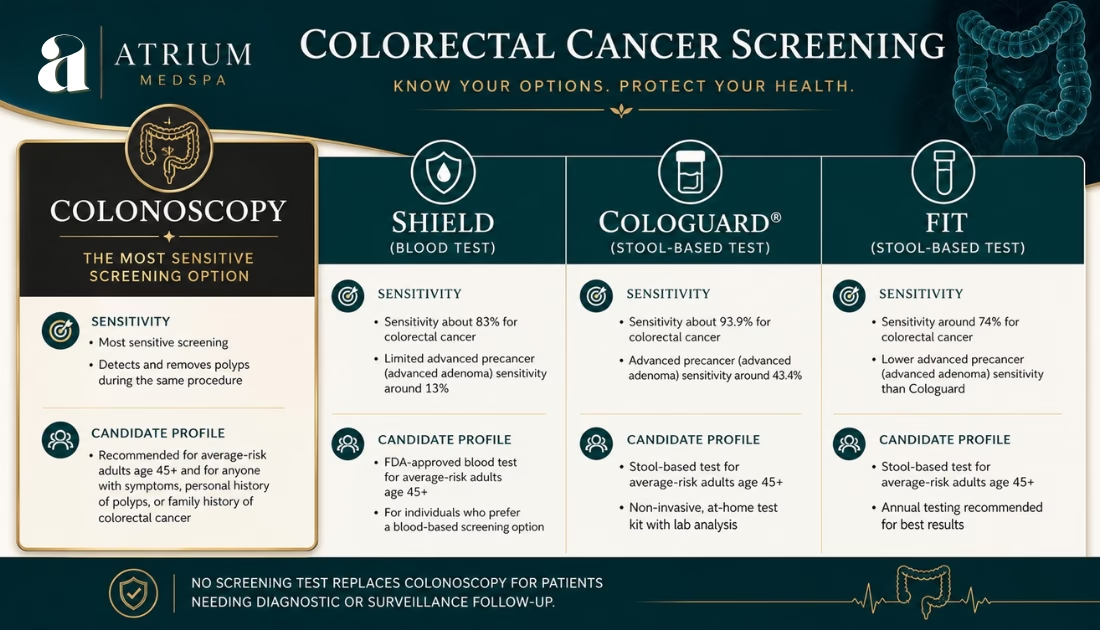
This distinction matters because the best screening strategy depends on what we’re trying to detect. Shield is useful as a screening option, but colonoscopy remains the most complete single test because it can both find cancer and remove polyps before they become cancerous. For that reason, Shield should be viewed as an option to expand access to screening, not as a replacement for colonoscopy, which remains the standard-of-care for colorectal cancer screening.
Why people consider the Shield blood test
- It uses a simple blood draw, which may feel easier for patients who have delayed screening.
- It can help more people take the first step toward colorectal cancer screening.
- It may fit better into a routine primary care or preventive visit than a procedure-based test.
- In some patients, it may also provide information about signals associated with cancers outside the colon.
What Shield can and cannot do
Shield can detect some colorectal cancers, but it is better at detecting established cancer than at detecting precancerous lesions. That’s one of its major limitations, because preventing colon cancer depends not only on finding cancer early, but also on finding and removing polyps before they become malignant. Colonoscopy remains the gold standard for that reason.
Clinical data reviewed by the FDA showed that Shield detected colorectal cancer in about 83% of cases, but it detected only a much smaller fraction of advanced precancerous lesions. It’s also less sensitive for very early disease than later-stage disease, which means a negative Shield result should never be treated as a guarantee that no disease is present.
Shield may also identify signals associated with cancers beyond colorectal cancer, which makes it broader than a colon-only screen in concept. Still, if the concern is colon cancer prevention specifically, colonoscopy remains the test that most directly answers the question and can intervene at the same time.
Who may be a good fit?
The FDA indication is for adults age 45 and older who are at average risk for colorectal cancer and need screening. In practical terms, that means someone without symptoms and without a personal or family history that would move them into a higher-risk screening category. The ideal patient is someone who is appropriate for screening, understands the limitations of the test, and is willing to follow up with colonoscopy if the result is positive.
Shield may be especially useful for patients who have been avoiding screening because they are hesitant about colonoscopy or are unlikely to complete stool-based screening. It can lower the barrier to getting started, which may help patients who would otherwise remain unscreened. In most cases, insurance coverage may be available for eligible patients, depending on the details of their plan and whether they meet screening criteria.
Who is not a candidate?
Shield is not ideal for people younger than 45 or in people who are not average risk. That includes patients with a personal history of colorectal cancer, adenomas, inflammatory bowel disease, hereditary syndromes such as Lynch syndrome or familial adenomatous polyposis, or a strong family history that would justify higher-risk screening recommendations. These patients need a different strategy, and colonoscopy is usually the more appropriate path.
Shield is also not intended to replace diagnostic colonoscopy when symptoms are present, such as rectal bleeding, unexplained anemia, or a change in bowel habits. It should not be used as a shortcut around recommended surveillance testing in patients who already need closer colon follow-up. If a patient is already in a higher-risk category, the test is generally not the right fit.
What the results can mean
A positive result means that a colorectal cancer-associated signal was detected and colonoscopy is needed to look directly at the colon. It does not mean someone definitely has cancer, but it does mean the next step should be diagnostic evaluation rather than reassurance alone.
A negative result means no signal was detected, but it does not completely rule out cancer or precancer. Because no blood test is perfect, patients still need to stay engaged in regular screening and should not interpret a negative result as permission to skip future guideline-based screening. Colonoscopy remains the most comprehensive screening option for colorectal cancer prevention.
Important limitations to understand
- Shield is a screening test, not a diagnostic test.
- A positive result must be followed by colonoscopy.
- A negative result does not rule out colorectal cancer or precancer.
- Shield is less effective at detecting precancerous polyps than colonoscopy.
- It may also miss early or low-shedding cancers, so false negatives can occur.
- It should be used alongside, not instead of, standard colorectal screening.
Shield and preventive screening at Atrium Medspa
At Atrium Medspa, we offer Shield for patients who want a more accessible way to begin the colorectal screening conversation. We think the most important part of the visit is helping patients understand what the test can do, what it cannot do, and when colonoscopy is still the better choice. That honest framing helps patients make a smarter decision.
Many patients appreciate having a screening option that is simple, familiar, and easier to complete. At the same time, we are careful to emphasize that the best prevention strategy is not “one test for everyone,” but the right test for the right patient at the right time. In most cases, insurance coverage may be available for eligible patients, and we review that with patients during the consultation.
What to expect at your visit
- We review your age, symptoms, family history, and prior screening history to see whether Shield is appropriate.
- If you are eligible, your blood draw is performed in-office.
- When results return, we explain what they mean in plain language and discuss next steps.
- If the result is positive, the next step is colonoscopy. If it is negative, you should still stay current with recommended screening over time.
Schedule at Atrium Medspa
Atrium Medspa in Upper Saddle River, NJ offers Shield colorectal cancer screening for eligible adults age 45 and older as part of a preventive health conversation.
To schedule, contact us to book a consultation and discuss whether Shield screening is appropriate for you, or whether colonoscopy is the more appropriate standard-of-care option.
Written by Atrium Medspa Editorial Team & medically reviewed for accuracy by Michael Klein, MD, FACS. This content is intended solely for general education and should not be interpreted as medical advice or a recommendation for any specific treatment, medication, or procedure. No physician-patient relationship is created by your use of this content. Healthcare decisions should be made in consultation with a qualified licensed clinician who can evaluate your individual history, symptoms, risks, and goals. If you are experiencing a medical emergency, call 911 or seek immediate emergency care.
Frequently Asked Questions
No. Shield is a screening test. A positive Shield result requires diagnostic colonoscopy for confirmation and tissue diagnosis. Shield cannot by itself confirm or stage cancer.
No. Shield is intended to complement guideline-recommended screening options. Colonoscopy remains the standard for both detection and removal of precancerous polyps; stool tests and colonoscopy remain accepted screening pathways.
Shield is indicated for adults age 45 and older who are at average risk and need colorectal cancer screening. Eligibility must be confirmed by a clinician before ordering the test.
Shield is not appropriate for people younger than 45, or those at higher risk (personal history of colorectal cancer or adenomas, inflammatory bowel disease, hereditary syndromes, strong family history), or people with concerning symptoms who need diagnostic colonoscopy.
Insurance coverage varies, but many eligible patients may have Shield covered; Atrium Medspa verifies benefits before testing and will discuss any expected out-of-pocket costs. Coverage depends on plan rules, patient age, and screening history.
A positive result means a colorectal cancer-associated signal was detected; the next step is colonoscopy for direct visualization, biopsy if needed, and further evaluation by gastroenterology or oncology as appropriate.
A negative result means no signal was detected by Shield, but it does not rule out cancer or precancer. Continue recommended screening and routine follow-up as advised by your clinician.