



Best Masseter Botox in NJ: What to Know Before You Book
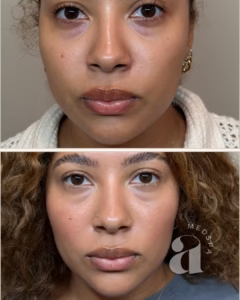
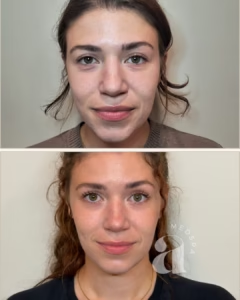
OCTOBER 15, 2026 || Masseter Botox, a nonsurgical treatment that relaxes the masseter muscles—the powerful chewing muscles at the back corners of the jaw, is rapidly gaining in popularity this year. For many people, it softens a wide or square lower face, reduces the appearance of jaw clenching, and can help relieve symptoms related to teeth grinding and jaw tension. If you are searching for the best masseter Botox in New Jersey, the most important question is not simply “Who has the lowest price?”, but rather whether the injector understands facial anatomy, uses authentic product, individualizes dosing, and practices within a properly supervised medical environment.
What masseter Botox is
The masseter is one of the primary muscles of mastication, or chewing. It sits along the angle and back portion of the mandible, and it becomes enlarged (or “hypertrophic”) in some people because of genetics, habitual clenching/teeth grinding, or repetitive jaw-muscle overuse. When the masseter hypertrophies, it can create a broader, more angular lower face. Some patients seek treatment for cosmetic facial balancing; others seek it because they wake with jaw soreness, clench during the day, or have been told they grind their teeth.
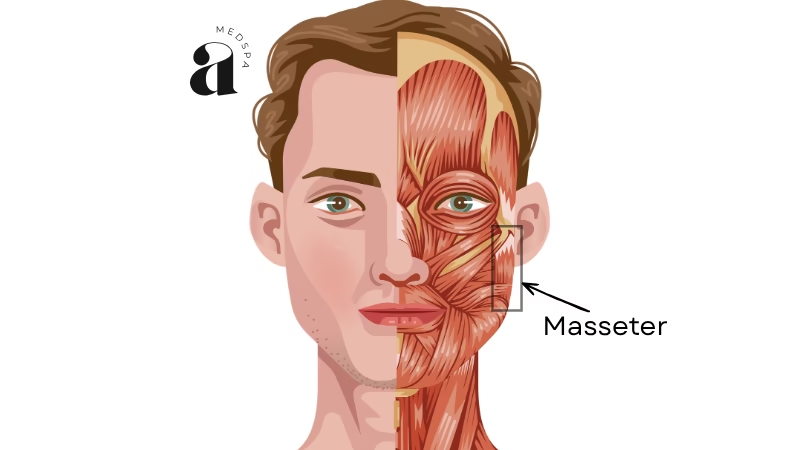
“Masseter Botox” usually refers to an injection of botulinum toxin type A (“Botox”) into one or both masseter muscles. The treatment temporarily reduces the muscle’s ability to contract forcefully, and in doing so, the muscle may become less bulky, causing the lower face to appear softer or more tapered. The same principle is used in other areas of the face, but because the masseter is a much larger and stronger muscle, treatment generally requires more units than typical upper-face wrinkle treatment (as a general rule, the bigger the muscle, the more tox is needed).
It’s important to distinguish between cosmetic goals and functional goals; a patient with a square jawline may want subtle slimming, while a patient who clenches their teeth (“bruxism”) may want reduced clenching force and less muscle fatigue. Your injector should assess facial proportions, bite function, muscle thickness, and symptoms before recommending a dose. Of note, masseter tox isn’t a substitute for dental evaluation, a night guard, or management of temporomandibular joint (“TMJ”) disorders when those problems are present.
How it works
Botulinum toxin works by targeting the SNARE complex consists of several different proteins at junction of the nerve and the muscle; this targeting results in a temporary interruption of the signal between nerves and muscles, which reduces muscle contraction in the treated area. When injected into the masseter, it decreases the activity and bulk of the muscle over time.
Masseter tox injections are typically placed into the belly of the masseter muscle on each side. Many providers use a small number of injection points per side, often guided by asking the patient to clench so the muscle can be palpated and outlined. Tthe appropriate dose varies substantially by anatomy, muscle strength, treatment goals, and the specific product used. Results aren’t immediate; most patients begin to notice reduced clenching or a softer jaw contour within one to three weeks, with fuller results developing over roughly four to six weeks. Because the effect is temporary, muscle activity gradually returns, usually over three to four months. Patients who clench heavily may metabolize or “use up” the effect faster than patients seeking purely cosmetic slimming.
What Masseter tox can do
Masseter Botox can produce both aesthetic and comfort-related benefits. Cosmetically, it may reduce the width of the lower face when the width is caused by prominent masseter muscles rather than bone structure, buccal (cheek) fat, or submental (under the chin) fullness. It can soften a square jawline, improve lower-face balance, and create a more tapered transition from the cheeks to the jaw. It is particularly useful for patients whose facial width is primarily muscular.
Functionally, reducing masseter activity may lessen the force generated during clenching and grinding. Research suggests that masseter tox can decrease masseter hypertrophy, reduce joint stress, and improve jaw function in appropriately selected patients. Some patients report fewer morning headaches, less jaw fatigue, less tooth pressure, and improved comfort related to clenching. However, Botox does not correct the underlying cause of bruxism, protect teeth from wear, or replace dental care. Anyone with significant jaw pain, clicking, locking, bite changes, or suspected sleep bruxism should also be evaluated by a dentist or orofacial pain specialist.
Common brand names
Patients often say “Botox” to mean any neuromodulator, but Botox is a specific brand. In the United States, several FDA-approved botulinum toxin type A products are commonly used for aesthetic and therapeutic purposes. They differ in formulation, diffusion characteristics, dosing conventions, onset, and duration, so units are not automatically interchangeable between products.
Common brands include Botox, Dysport, Jeuveau, Daxxify, Xeomin, and others.
For masseter treatment, the product choice matters less than the injector’s familiarity with the specific product chosen. A provider should be able to explain which neuromodulator they use, why they selected it, how they dose it for masseter treatment, and what results to expect. Be cautious if a practice cannot identify the brand, cannot show the product vial, or offers an unusually low price that suggests diluted, expired, improperly stored, or non-authentic product.
Is it FDA approved for the masseter?
This is a nuance many patients don’t realize: masseter injection is generally considered an off-label use in the United States. Botulinum toxin products themselves are FDA-approved medications, but no botulinum toxin product has historically been FDA-approved specifically for masseter injection. Off-label, however, doesn’t mean unsafe or inappropriate; it means a licensed clinician may use an approved medication in a manner supported by clinical judgment and evidence but outside the exact labeled indication.
In August, Allergan announced that the FDA accepted its supplemental application for BOTOX Cosmetic for temporary improvement in the appearance of marked to very marked masseter muscle prominence in adults. If approved, it would be the first neurotoxin approved in the U.S. specifically for that indication.
What a good consultation includes
A strong consultation should feel medical, not transactional. The injector should ask about clenching, grinding, jaw pain, headaches, dental history, prior cosmetic treatments, medications, and any neurologic conditions. They should examine your face at rest and during clenching, palpate the masseter muscles, assess your lower-face shape, and determine whether the masseter is actually the main contributor to the appearance you want to change.
You should receive a clear plan that includes:
- The specific product being used and why.
- The estimated number of units per side.
- The injection locations and expected change.
- When results should appear and how long they are expected to last.
- Possible side effects, including temporary chewing weakness, asymmetric smile, or changes in jaw function.
- What to avoid immediately afterward, such as vigorous rubbing of the area or strenuous jaw activity, according to the practice’s protocol.
- A follow-up plan, especially for first-time patients.
Avoid practices that quote a fixed “jaw slimming” package without examining you, refuse to identify the product, or pressure you into a large dose on the first visit. Conservative, anatomy-guided treatment is usually preferable, particularly for a first treatment. When in doubt, the practice should use less units; you can always add refinement later, but correcting an over-treated masseter means having to wait for the effect to wear off.
How to find the best place in New Jersey
The best masseter Botox providers in New Jersey are those who combines medical legitimacy with aesthetic judgment. Because botulinum toxin is a prescription medication and injections are medical procedures, treatment should occur under appropriate physician oversight. In New Jersey, medical aesthetics are treated as the practice of medicine, and injectables should be performed by appropriately licensed clinicians operating within their scope and under required physician collaboration or supervision.
When comparing practices, look for the following:
- Licensed medical provider: Ideally, treatment is performed by a physician, dentist with appropriate training, nurse practitioner, or physician assistant. Ask exactly who will inject you and what their license and training are.
- Active medical direction: A reputable practice should have a physician medical director or collaborating physician involved in protocols, supervision, chart review, quality assurance, and emergency planning. New Jersey guidance describes the medical director as responsible for approving clinical protocols, supervising clinical staff, reviewing charts, and maintaining adverse-event procedures.
- Relevant anatomy experience: Masseter treatment is not the same as treating forehead lines. Ask how many masseter treatments the injector performs, how they manage asymmetry, and how they approach patients with bruxism or temporomandibular symptoms.
- Authentic product and transparent sourcing: The practice should use FDA-approved botulinum toxin from legitimate suppliers and be willing to tell you the exact brand. Do not choose a provider based solely on per-unit pricing without knowing the product and dose.
- Clean safety record and emergency preparedness: Ask about complication protocols, adverse-event documentation, and how the practice handles unexpected reactions. A well-run practice should be able to answer comfortably.
- Before-and-after photos of actual patients: Look for consistent, natural-looking results in patients with similar facial structure. Beware of heavily filtered or stock-style images.
- Reasonable pricing with clear dosing: Ask whether the price is per unit, per area, or a package. For masseter treatment, the total dose matters more than the advertised unit price.
Questions to ask before booking
Bring these questions to your consultation:
- Who exactly will perform my injections, and what are their credentials?
- Which botulinum toxin brand will you use, and why?
- How many units do you anticipate per side, and what is the total cost?
- Are you treating me for cosmetic slimming, clenching, both, or something else?
- How will you avoid over-treatment or an unnatural change in my smile or bite?
- What side effects should I expect, and what would require me to contact the office?
- How long do you expect my results to last?
- What is your plan if I develop asymmetry or insufficient relaxation?
- Who is the supervising or collaborating physician, and how are they involved in patient care?
Bottom line
Masseter Botox can be an excellent option for softening a prominent jawline and reducing the functional impact of clenching, but it is a medical treatment that requires individualized planning. When choosing the best masseter Botox provider, make sure that they come from a practice that prioritizes accurate diagnosis, authentic FDA-approved product, appropriate physician oversight, conservative dosing, and honest expectations. A lower price is only a good deal when the injector, product, dose, and safety standards are equally strong.
Written by Atrium Medspa Editorial Team & medically reviewed for accuracy by Michael Klein, MD, FACS. This content is intended solely for general education and should not be interpreted as medical advice or a recommendation for any specific treatment, medication, or procedure. No physician-patient relationship is created by your use of this content. Healthcare decisions should be made in consultation with a qualified licensed clinician who can evaluate your individual history, symptoms, risks, and goals. If you are experiencing a medical emergency, call 911 or seek immediate emergency care.
Frequently Asked Questions
Yes. You can generally eat and drink normally after treatment, though many providers recommend avoiding very hard, chewy, or sticky foods for the first day or two if your jaw feels fatigued. Temporary chewing weakness can occur because the masseter muscle is intentionally being relaxed; it is usually most noticeable with foods like steak, gum, or hard candy and tends to improve as the treatment settles.
It should not change your smile when placed correctly, but an uneven or weakened smile can occasionally occur if the medication affects nearby expression muscles, such as the risorius or zygomaticus major. This is usually temporary and improves as the botulinum toxin wears off, though it can last weeks to months depending on the dose and placement.
Most practices advise avoiding strenuous exercise, heavy lifting, and activities that significantly raise your heart rate for the remainder of the day or for about 24 hours. The goal is to minimize bruising, swelling, and unnecessary movement or pressure around the injection sites. Follow your injector’s specific aftercare instructions, since protocols can vary.
Elective masseter Botox is generally postponed during pregnancy because there aren’t enough studies to establish safety. Breastfeeding is more nuanced: limited studies have not detected onabotulinumtoxinA in breast milk or reported side effects in breastfed children, but many clinicians still prefer to defer elective treatment unless there is a clear medical need. Discuss your individual situation with both your injector and obstetric or pediatric clinician.