



Cancer Screening: Are We Missing an Opportunity Beyond Standard Tests?
APRIL 8, 2026 || Today, routine cancer screening saves lives by catching many cancers early, when they are most treatable. Tests like mammograms, Pap tests, colon cancer screening, lung cancer screening, and prostate checks have changed the way we approach prevention. Yet for many adults, there is still a gap: several of the deadliest cancers, like ovarian and pancreatic cancer, still don’t have routine screening tests at all.
| Screening test | Common recommendation |
|---|---|
| Mammography | Often begins around age 40 for many women, or earlier if high risk. |
| Pap test / cervical cancer screening | Begins around age 21 for many women and continues at regular intervals through age 65 in many cases. |
| Colorectal cancer screening | Usually begins at age 45 for most adults. |
| Lung cancer screening | Recommended for certain adults at higher risk, usually based on age and smoking history. |
| Prostate cancer screening | Often discussed starting around ages 40 to 50 depending on risk factors and shared decision‑making. |
And while the screenings that we do have are essential, but they still leave many cancers without a standard early detection option. That is where newer testing approaches can help expand what screening can do.
That gap raises an important question: if standard screening tools don’t cover every cancer, can we broaden our approach beyond the “usual” screenings without overtesting or creating unnecessary anxiety?
Some providers and patients have turned to full‑body MRI as a way to look for hidden disease, hoping a detailed scan can reveal problems before symptoms appear. The appeal is clear: a single, sweeping look at the body can feel like a comprehensive “health check.”
In practice, however, full‑body MRI screening has significant limitations. Studies of whole‑body MRI for prevention show a high rate of incidental findings, many of which turn out to be harmless. These findings often lead to follow‑up tests, biopsies, imaging, and procedures that are unnecessary but still carry risk, cost, and anxiety. As a result, medical organizations generally do not recommend full‑body MRI for routine screening in healthy people.
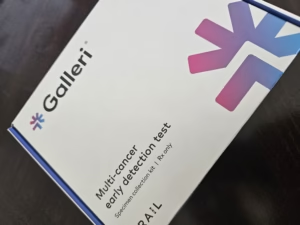
One answer is emerging in the form of advanced screening tools that use simple blood tests to look for early signs of cancer. At Atrium, we now offer one of these tools, Galleri, as an option for patients who want a more comprehensive way to think about cancer screening.
How a liquid biopsy works
One newer approach uses a blood‑based “liquid biopsy” that looks for tiny pieces of DNA shed by cancer cells into the bloodstream. Instead of waiting for a symptom to prompt a scan or tissue biopsy, the test analyzes these fragments to look for signs that cancer may be present.
Advanced tests like Galleri focus on methylation patterns in the DNA. Methylation is a natural chemical “tag” on DNA that helps the test tell the difference between healthy cells and cancer cells. By reading these patterns, the test can look for a cancer signal and, if a signal is found, estimate where in the body that signal may have started.
What makes this different from standard screening?
Unlike a single‑cancer screening test (such as a mammogram or a colonoscopy), a multi‑cancer blood test is designed to look for signals from many types of cancer at once. That can be especially helpful for cancers that are hard to catch early and do not have routine screening tests today.
Even so, this technology is not foolproof. It does not detect every cancer, and false positive and false negative results can happen. A “No Cancer Signal Detected” result does not completely rule out cancer, and a “Cancer Signal Detected” result is not a diagnosis — it means additional testing is needed. This first example — the false negative — is why screeening tools like Galleri should be used alongside routine cancer screenings, not instead of them. Mammograms, Pap tests, colorectal screening, lung cancer screening, and prostate checks remain essential parts of preventive care.
Think of advanced blood tests more like an added layer: a way to broaden early detection, especially for cancers that are often found too late or do not have standard screening tools available.
Screening at Atrium
Atrium now offers Galleri as an option for patients who want a more proactive approach to cancer screening. If you are interested in learning whether this test fits your goals and risk profile, we can help you decide what makes sense for you.